

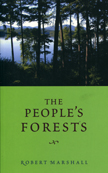
The People's Forests

“Mr. Marshall knows his subject thoroughly and writes about it with accuracy and dependability. . . . His book is richly informative, well thought out, soundly backed by scientific and economic knowledge and, whatever one may think about his primary thesis, its argument will surely stir its readers to fresh consideration of the question and ought to help greatly in rousing public attention and sentiment.”—New York Times Book Review, November 5, 1933
“...should be a compulsory text in every American public school.”—The Nation, 1933
“The most valuable feature of the work is the clear showing that forests are not merely of service to industries and to consumers of products, but that they are of equal importance in social benefits to a large portion of the population.”—Saturday Review of Literature,1934
“As one of the principal founders of the Wilderness Society, Marshall has long been recognized as one of the most important conservation leaders of the twentieth century. His intellectual influence, his vision, and his commitment to activism still guide the conservation community as it moves into the twenty-first century.”—William Meadows, president, Wilderness Society
“As a hundred-year-old association of advocates for wilderness in New York’s Adirondack and Catskill Forest Preserves, we are always revisiting the roots of the wilderness movement for inspiration. The republication of Rob Marshall’s The People’s Forests will directly help in our efforts.”—David H. Gibson, executive director, Association for the Protection of the Adirondacks
Devoted conservationist, environmentalist, and explorer Robert Marshall (1901-1939) was chief of the Division of Recreation and Lands, U.S. Forest Service, when he died at age thirty-eight. Throughout his short but intense life, Marshall helped catalyze the preservation of millions of wilderness acres in all parts of the U.S., inspired countless wilderness advocates, and was a pioneer in the modern environmental movement: he and seven fellow conservationists founded the Wilderness Society in 1935. First published in 1933, The People's Forests made a passionate case for the public ownership and management of the nation's forests in the face of generations of devastating practices; its republication now is especially timely.
Marshall describes the major values of forests as sources of raw materials, as essential resources for the conservation of soil and water, and as a “precious environment for recreation” and for “the happiness of millions of human beings.” He considers the pros and cons of private and public ownership, deciding that public ownership and large-scale public acquisition are vital in order to save the nation's forests, and sets out ways to intelligently plan for and manage public ownership.
The last words of this book capture Marshall's philosophy perfectly: “The time has come when we must discard the unsocial view that our woods are the lumbermen's and substitute the broader ideal that every acre of woodland in the country is rightly a part of the people's forests.”