

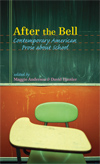
After the Bell

“Our schooling makes us brave or timid, adept socially or not; it makes us team players or selfish players. Children may understand the larger implications of their classes long before they can articulate their feelings. So remember, when you urge your children to hurry lest they miss the bus, you urge them toward a complicated future, much of which is subject to random luck.”—Jane Kenyon in After the Bell
“They said daydreaming was against the law, but some of us escaped, slipping out windows and over cyclone fences, some of us flying away with heads like balloons. We taught our dogs to love the flavor of homework and became expert forgers of our parents’ signatures. We knew they were teaching us how to die but some of us said no in our stealthy and stubborn ways.”—Vern Rutsala in After the Bell
The sixty-two short essays in After the Bell describe in many voices the emotional complexity and historical record of one experience most of us have in common: elementary and secondary school, from our first day all the way to graduation twelve years later. Whether public or private, rural or urban, school is the first place we navigate on our own, learning how we stand apart, how we stand out, and where we do—or don’t—fit in.
The essays are by emerging as well as established fiction writers, poets, social commentators, and educational theorists. Told from the point of view of students, teachers, parents, and administrators through the multiple perspectives of race, class, physical and intellectual abilities, and sexuality, the stories reveal how memories of our school days haunt and sustain us.
As Naomi Shihab Nye notes, “there will never be a last day of school.” That’s the good news and the bad news about our common experience. From the staunchly Lutheran brick schoolhouse of Garrison Keillor’s New Albion Academy in 1948 to Annie Thoms’s Manhattan high school at Ground Zero on September 11, 2001, from Alberto Ríos’s confusion as a bilingual child in a monolingual classroom to Henry Louis Gates’s hard lessons in the segregated South, the essays in this funny, poignant, and stimulating collection capture the many public worlds of the school community as well as its idiosyncratic secrets.
Sherman Alexie
from "Indian Education"
Maggie Anderson
In the Art Room
Rane Arroyo
The Invisible Boy in a Jock
Esther Royer Ayers
from "Feeling Different"
Phyllis Barber
from How I Got Cultured: A Nevada Memoir
Jan Beatty
Flurry
Mark Brazaitis
The Invisibles
Christopher Buckley
My Time On Earth
David Citino
Let's Move Our Chairs and Desks Around and See What We Can See
Robert Coles
Here and Now We Are Walking Together
Katie Daley
The Word according to Mr. Coosak
Toi Derricotte
from The Black Notebooks: An Interior Journey
Annie Dillard
from An American Childhood
Mark Doty
from Firebird: A Memoir
Violet A. Dutcher
Learning Politics in the First Grade
Joyce Dyer
The Day I Stopped Hating Cheerleaders
Linda Dyer
Votive
Kathy Evans
After the Facts: Poetry and the Sophomores
Henry Louis Gates, Jr.
from Colored People: A Memoir
Diane Gilliam
Does Not Use Free Time Wisely
Richard Hague
from Milltown Natural: Essays and Stories from a Life
David Hassler
Wrestling Mr. Dietz
Ruth Ellen Hendricks
Professional Knowledge and Practice
William Heynen
The End
Faith S. Holsaert
History Dancing
Hank Hudepohl
Friday Night Heroes
Lawson Fusao Inada
Our Song
Julia Spicher Kasdorf
Portrait of a Poet as a Public School Kid
Garrison Keillor
from "School"
Jane Kenyon
Dreams of Math
Jesse Lee Kercheval
from "Everything You Always Wanted to Know"
Barbara Kingsolver
How Mr. Dewey Decimal Saved My Life
Leonard Kress
Yearbook
Stephen Kuusisto
from Planet of the Blind
Philip Levine
from The Bread of Time: Toward an Autobiography
Audre Lorde
from Zami: A New Spelling of My Name
Peter Markus
I Am a Cloud: Revisited, or an Open Letter to My Third Grade Teacher
Rebecca McClanahan
Orbit
Kenneth A. McClane
The Mitchell Movement
Brenda Miller
from "Three Lessons"
Naomi Shihab Nye
Last Day of School
Gregory Orr
from The Blessing
Vivian Gussin Paley
from Kwanzaa and Me: A Teacher's Story
Maj Ragain
Under the Guidance of Falling Petals
Alberto Rios
from "The Body of My Work"
Suzanne Rivecca
The Music Teachers of St. Augustine's Elementary
Luis J. Rodriguez
from Always Running: La Vida Loca, Gang Days in L.A.
Richard Rodriguez
from "Asians"
David Romtvedt
from "Some Shelter"
Vern Rutsala
Some of Us
Scott Russell Sanders
The Real Questions
Susan Richards Shreve
from Tales Out of School: Contemporary Writers on Their Student Years
Theodore R. Sizer
from The Red Pencil: Convictions from Experience in Education
Larry Smith
from "My Working-Class Education"
Gary Soto
Catholics
Michael Steinberg
High School Baseball Tryouts
Judith Gold Stitzel
Milk Money
Lawrence Sutin
One of the Men in the White Coats
Annie Thomas
from With Their Eyes: September 11th—The View from a High School at Ground Zero
Jane Tompkins
Reverie
Bruce Weigl
Before and After
Meredith Sue Willis
What I Learned in First Grade
Notes on Contributors
Acknowledgments