

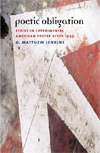
Poetic Obligation


"This is a very fine study of the complex issues surrounding an ethical practice of American avant-garde poetry. In both its theoretical model centering on ethics and its attention to a range of authors from Oppen to Hejinian, Poetic Obligation has something important to say."—Peter Baker, author, Obdurate Brilliance
"This is an interesting and important project. That reading poststructuralist poetries challenges prior ways of construing the relation of ethics to poetics-to the extent that it is construed at all!—is an exciting starting point for an inquiry into a different understanding of how changes in conceptualizing ethical categories might elucidate new poetics, and vice versa."—Joan Retallack, author, Memnoir and The Poethical Wager
Since at least the time of Plato's Republic, the relationship between poetry and ethics has been troubled. Through the prism of what has been called the "new" ethical criticism, inspired by the work of Emmanuel Levinas, G. Matthew Jenkins considers the works of Objectivists, Black Mountain poets, and Language poets in light of their full potential to reshape this ancient relationship.
American experimental poetry is usually read in either political or moral terms. Poetic Obligation, by contrast, considers the poems of Louis Zukofsky, Charles Reznikoff, George Oppen, Edward Dorn, Robert Duncan, Susan Howe, and Lyn Hejinian in terms of the philosophical notion of ethical obligation to the Other in language. Jenkins's historical trajectory enables him to consider the full breadth of ethical topics that have driven theoretical debate since the end of World War II. This original approach establishes an ethical lineage in the works of twentieth-century experimental poets, creating a way to reconcile the breach between poetry and the issue of ethics in literature at large.
With implications for a host of social issues, including ethnicity and immigration, economic inequities, and human rights, Jenkins's imaginative reconciliation of poetry and ethics will provide stimulating reading for teachers and scholars of American literature as well as advocates and devotees of poetry in general. Poetic Obligation marshals ample evidence that poetry matters and continues to speak to the important issues of our day.
Preface
Introduction: The Double-Double Turn
Part 1: Objectivist Poethics
1. Saying Obligation: George Oppen's Of Being Numerous
2. A Phenomenology of Judgement: Charles Reznikoff's Holocaust
Part 2: Excess and Eros
3. The Ethics of Excess: Edward Dorn's Gunslinger
4. The Body Ethical: Robert Duncan's Passages
Part 3: An Ethics of Sexual Alterity
5. The Nearness of Poetry: Susan Howe's The Noncomformist's Memorial
6. Permeable Ethics: Lynn Hejinian's The Cell
Conclusion: What Difference Does Poetic Obligation Make?
Notes
Bibliography
Index
To listen to Grant's interview on "Unobstructed" hosted by Alaina R. Alexander, please click here.